FOR PRE-ORDER ONLY – (Expected Delivery in Q1 of 2027.)
Alan the Android
A Printed Liquids and Nasals Speech Therapy Storybook | Pretzel Learning, LLC
Meet Alan, a cheerful little helper robot with a lot to learn, in this engaging, hand-illustrated speech therapy storybook designed to support articulation, language development, object identification, and meaningful communication!
Marcus is preparing for an exciting camping trip, and Alan the Android is ready to help him pack.
Marcus gives Alan a short list of supplies to collect: a brush and a light. It sounds simple, but Alan soon discovers that everyday objects aren't always what they seem!
Is a paintbrush the same as a toothbrush? Can a hairbrush clean teeth? And what makes a flashlight different from a lamp or lantern?
As Alan searches the house, he learns that objects can look alike or share similar names while serving very different purposes.
With Marcus's guidance, Alan discovers the importance of asking questions, listening carefully, and using descriptive details to identify the correct items.
Together, they learn that clear communication and patience can make even confusing tasks easier!
Purposefully Designed for Speech Therapy
Unlike traditional children's books that are later adapted for therapeutic use, Alan the Android was developed specifically for speech-language therapy from the very beginning. Its narrative, vocabulary, illustrations, and speech sound targets were intentionally selected to support meaningful communication practice.
Designed for SLPs and SLPAs working with individual students or mixed-goal therapy groups, the storybook provides opportunities to address articulation, language, vocabulary development, and functional communication objectives through a single narrative.
A distinguishing feature of this book is that understanding everyday object functions is essential to the story's progression. Alan must learn how objects are used to successfully complete his task, creating natural opportunities for students to practice semantic reasoning and functional language.
Targeted Articulation Through Connected Speech
The 28-page illustrated narrative places a primary emphasis on /l/, with additional opportunities to practice nasal consonants and /r/ within meaningful, connected speech.
Primary Articulation Target:
Additional Articulation Targets:
/n/ – need, no, lantern
/m/ – Marcus, more, room
/ŋ/ – camping, packing, helping
/r/ – robot, brush, ready
The narrative provides repeated opportunities to practice these speech sounds across varied words and sentence structures as students follow Alan's search.
Because several speech sound targets appear throughout the story, Alan the Android is adaptable for mixed-goal therapy groups, allowing clinicians to address different articulation objectives within the same narrative.
Building Functional Language Through Object Identification and Description
Beyond articulation, Alan the Android was intentionally developed to support object identification, object functions, descriptive vocabulary, and semantic relationships.
Throughout the story, Alan encounters objects with similar names or appearances but different purposes.
For example, paintbrushes, hairbrushes, and toothbrushes all belong to a general category of brushes. However, each is designed for a different task.
Similarly, lamps, lanterns, and flashlights all provide light, but their features and appropriate uses differ.
These comparisons provide opportunities for students to identify common objects, describe their physical characteristics, explain their functions, and determine which item is appropriate for a specific situation.
Clinicians can also encourage students to compare similarities and differences, categorize objects, and explain why one item would be more useful than another.
The language goal is not simply introduced through the story; it is the challenge Alan must solve. This allows vocabulary development and semantic reasoning to occur naturally within a meaningful narrative.
Supporting Problem Solving, Listening, and Clear Communication
As Alan encounters different objects, he must reconsider his assumptions and use new information to make better decisions.
Marcus also learns that giving clear, specific instructions is important when asking someone to complete a task.
Their interactions create opportunities to explore listening comprehension, following directions, asking clarifying questions, and communicating information accurately.
Students can practice identifying missing information, explaining misunderstandings, and suggesting ways Marcus might make his requests clearer.
Alan's mistakes also provide opportunities to discuss flexible thinking, learning from feedback, and trying a different approach when something doesn't work.
Because the story uses familiar household objects and everyday activities, clinicians can extend these concepts into practical communication situations beyond the therapy room.
Speech and Language Goals Supported
Primary Articulation: /l/ in connected speech
Additional Articulation: /n/, /m/, /ŋ/, and /r/
Phonological Awareness: Target sound identification and auditory discrimination
Object Identification: Recognizing and naming everyday objects
Object Functions: Understanding and explaining how objects are used
Semantic Development: Categorization, word relationships, and comparing similar objects
Expressive and Receptive Language: Descriptive vocabulary, comprehension, and functional communication
Following Directions: Listening comprehension and identifying requested items
Communication Repair: Asking clarifying questions and resolving misunderstandings
Narrative Skills: Sequencing, retelling, WH questions, and story comprehension
Higher-Level Language: Predictions, inferencing, cause-and-effect reasoning, and problem solving
Executive Functioning: Planning, flexible thinking, and evaluating choices
Social Communication: Perspective-taking, cooperation, and giving clear instructions
More Than a Storybook: Coordinated Therapy Activities
At Pretzel Learning, LLC, we believe speech therapy storybooks should serve as a foundation for meaningful, connected learning and not simply as supplemental reading materials.
That's why Alan the Android was developed with coordinated articulation, language, and phonological activities in mind from the beginning.
These companion resources build directly upon the book's characters, vocabulary, narrative events, and targeted speech sounds, allowing clinicians to reinforce familiar concepts across multiple therapy sessions.
Companion activities may include articulation practice, phoneme tracking, object identification, categorization, vocabulary development, and language-based exercises focused on object functions.
Coordinated companion activities are available separately as digital downloads on the Pretzel Learning website. These supplemental resources are not included with the purchase of the printed storybook.
Whether used independently or alongside its companion activities, Alan the Android provides clinicians with a flexible resource for addressing diverse communication goals while keeping students engaged in a story about curiosity, cooperation, and learning how everyday objects work.
Bring storytelling and speech therapy together with Pretzel Learning, where every story is built with communication in mind.
FOR PRE-ORDER ONLY – (Expected Delivery in Q1 of 2027.)
Alan the Android
A Printed Liquids and Nasals Speech Therapy Storybook | Pretzel Learning, LLC
Meet Alan, a cheerful little helper robot with a lot to learn, in this engaging, hand-illustrated speech therapy storybook designed to support articulation, language development, object identification, and meaningful communication!
Marcus is preparing for an exciting camping trip, and Alan the Android is ready to help him pack.
Marcus gives Alan a short list of supplies to collect: a brush and a light. It sounds simple, but Alan soon discovers that everyday objects aren't always what they seem!
Is a paintbrush the same as a toothbrush? Can a hairbrush clean teeth? And what makes a flashlight different from a lamp or lantern?
As Alan searches the house, he learns that objects can look alike or share similar names while serving very different purposes.
With Marcus's guidance, Alan discovers the importance of asking questions, listening carefully, and using descriptive details to identify the correct items.
Together, they learn that clear communication and patience can make even confusing tasks easier!
Purposefully Designed for Speech Therapy
Unlike traditional children's books that are later adapted for therapeutic use, Alan the Android was developed specifically for speech-language therapy from the very beginning. Its narrative, vocabulary, illustrations, and speech sound targets were intentionally selected to support meaningful communication practice.
Designed for SLPs and SLPAs working with individual students or mixed-goal therapy groups, the storybook provides opportunities to address articulation, language, vocabulary development, and functional communication objectives through a single narrative.
A distinguishing feature of this book is that understanding everyday object functions is essential to the story's progression. Alan must learn how objects are used to successfully complete his task, creating natural opportunities for students to practice semantic reasoning and functional language.
Targeted Articulation Through Connected Speech
The 28-page illustrated narrative places a primary emphasis on /l/, with additional opportunities to practice nasal consonants and /r/ within meaningful, connected speech.
Primary Articulation Target:
Additional Articulation Targets:
/n/ – need, no, lantern
/m/ – Marcus, more, room
/ŋ/ – camping, packing, helping
/r/ – robot, brush, ready
The narrative provides repeated opportunities to practice these speech sounds across varied words and sentence structures as students follow Alan's search.
Because several speech sound targets appear throughout the story, Alan the Android is adaptable for mixed-goal therapy groups, allowing clinicians to address different articulation objectives within the same narrative.
Building Functional Language Through Object Identification and Description
Beyond articulation, Alan the Android was intentionally developed to support object identification, object functions, descriptive vocabulary, and semantic relationships.
Throughout the story, Alan encounters objects with similar names or appearances but different purposes.
For example, paintbrushes, hairbrushes, and toothbrushes all belong to a general category of brushes. However, each is designed for a different task.
Similarly, lamps, lanterns, and flashlights all provide light, but their features and appropriate uses differ.
These comparisons provide opportunities for students to identify common objects, describe their physical characteristics, explain their functions, and determine which item is appropriate for a specific situation.
Clinicians can also encourage students to compare similarities and differences, categorize objects, and explain why one item would be more useful than another.
The language goal is not simply introduced through the story; it is the challenge Alan must solve. This allows vocabulary development and semantic reasoning to occur naturally within a meaningful narrative.
Supporting Problem Solving, Listening, and Clear Communication
As Alan encounters different objects, he must reconsider his assumptions and use new information to make better decisions.
Marcus also learns that giving clear, specific instructions is important when asking someone to complete a task.
Their interactions create opportunities to explore listening comprehension, following directions, asking clarifying questions, and communicating information accurately.
Students can practice identifying missing information, explaining misunderstandings, and suggesting ways Marcus might make his requests clearer.
Alan's mistakes also provide opportunities to discuss flexible thinking, learning from feedback, and trying a different approach when something doesn't work.
Because the story uses familiar household objects and everyday activities, clinicians can extend these concepts into practical communication situations beyond the therapy room.
Speech and Language Goals Supported
Primary Articulation: /l/ in connected speech
Additional Articulation: /n/, /m/, /ŋ/, and /r/
Phonological Awareness: Target sound identification and auditory discrimination
Object Identification: Recognizing and naming everyday objects
Object Functions: Understanding and explaining how objects are used
Semantic Development: Categorization, word relationships, and comparing similar objects
Expressive and Receptive Language: Descriptive vocabulary, comprehension, and functional communication
Following Directions: Listening comprehension and identifying requested items
Communication Repair: Asking clarifying questions and resolving misunderstandings
Narrative Skills: Sequencing, retelling, WH questions, and story comprehension
Higher-Level Language: Predictions, inferencing, cause-and-effect reasoning, and problem solving
Executive Functioning: Planning, flexible thinking, and evaluating choices
Social Communication: Perspective-taking, cooperation, and giving clear instructions
More Than a Storybook: Coordinated Therapy Activities
At Pretzel Learning, LLC, we believe speech therapy storybooks should serve as a foundation for meaningful, connected learning and not simply as supplemental reading materials.
That's why Alan the Android was developed with coordinated articulation, language, and phonological activities in mind from the beginning.
These companion resources build directly upon the book's characters, vocabulary, narrative events, and targeted speech sounds, allowing clinicians to reinforce familiar concepts across multiple therapy sessions.
Companion activities may include articulation practice, phoneme tracking, object identification, categorization, vocabulary development, and language-based exercises focused on object functions.
Coordinated companion activities are available separately as digital downloads on the Pretzel Learning website. These supplemental resources are not included with the purchase of the printed storybook.
Whether used independently or alongside its companion activities, Alan the Android provides clinicians with a flexible resource for addressing diverse communication goals while keeping students engaged in a story about curiosity, cooperation, and learning how everyday objects work.
Bring storytelling and speech therapy together with Pretzel Learning, where every story is built with communication in mind.


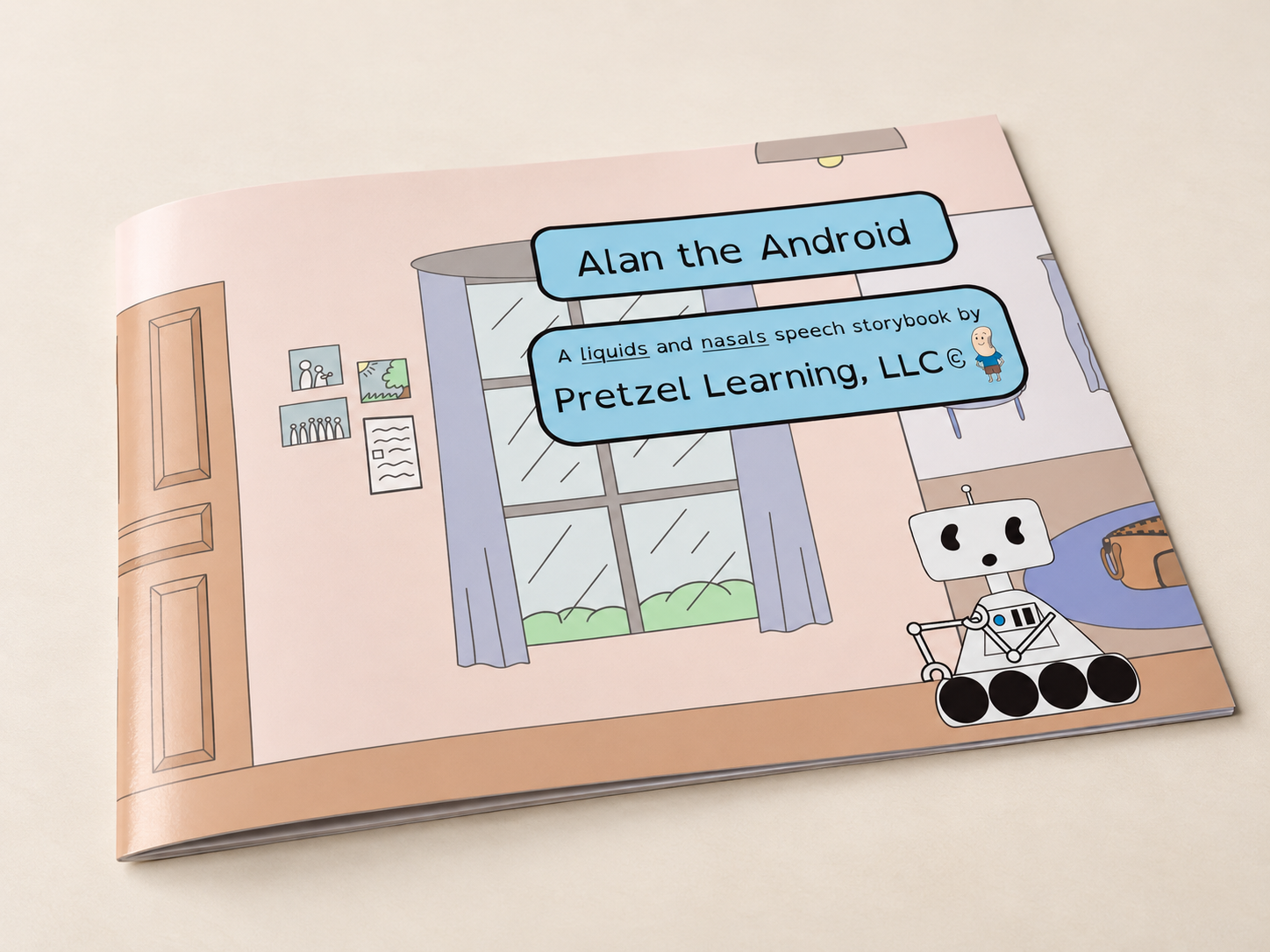 Image 1 of 1