FOR PRE-ORDER ONLY – (Expected Delivery in Q1 of 2027.)
The Kiwi 500
A Printed /k/ and /g/ Articulation Speech Therapy Storybook | Pretzel Learning, LLC
Get ready, get set, GO! Join Kiwi the Corgi in this exciting, hand-illustrated speech therapy storybook designed to support articulation, language development, emotional regulation, and meaningful communication!
Kiwi loves to run! Wearing her green racing jersey, she creates her very own racing challenge through the house: The Kiwi 500.
Determined to beat her fastest time, Kiwi races around corners and through rooms while her friends Kate and Gabby cheer her on.
But Kiwi's excitement quickly becomes a problem!
As she focuses on going faster, she begins overlooking obstacles in her path. After a few unexpected crashes, Kiwi must decide whether to give up or try again.
With encouragement from her friends, Kiwi discovers that slowing down, paying attention, and learning from mistakes can help her reach the finish line safely.
Through Kiwi's racing adventure, students explore perseverance, problem solving, self-awareness, and the importance of making thoughtful choices.
Purposefully Designed for Speech Therapy
Unlike traditional children's books that are later adapted for therapeutic use, The Kiwi 500 was developed specifically for speech-language therapy from the very beginning. Its narrative, vocabulary, illustrations, and speech sound targets were intentionally selected to support meaningful communication practice.
Designed for SLPs and SLPAs working with individual students or mixed-goal therapy groups, the storybook provides opportunities to address articulation, language, emotional regulation, and social communication objectives through a single narrative.
A distinguishing feature of this book is its intentional concentration of /k/ and /g/, providing repeated opportunities to practice velar consonants within meaningful, connected speech.
Targeted Articulation Through Connected Speech
The 26-page illustrated narrative emphasizes /k/ and /g/, two velar stop consonants that share the same place and manner of articulation but differ in voicing.
Primary Articulation Targets:
/k/ – Voiceless velar stop: Kiwi, Kate, quick, crash
/g/ – Voiced velar stop: Gabby, go, green, again
Additional Articulation Targets:
The story provides opportunities to practice these sounds across varied words and sentence structures as students follow Kiwi's racing adventure.
The repeated /k/ and /g/ targets are particularly relevant for clinicians addressing velar fronting, a phonological process in which velar sounds may be replaced by sounds produced farther forward in the mouth, such as /t/ and /d/.
Clinicians can use the narrative to reinforce accurate velar production, auditory discrimination, and speech sound practice within connected speech.
Because the story also incorporates several additional consonants, it offers flexibility for mixed-goal therapy groups.
Building Perseverance, Self-Regulation, and Problem Solving
Beyond articulation, The Kiwi 500 explores the importance of persistence, safety awareness, and learning from mistakes.
Kiwi begins her race with excitement and determination, but her desire to move faster leads her to overlook important details in her surroundings.
When she slips and crashes, she experiences frustration and discouragement.
Rather than giving up, Kiwi learns to recognize her emotions, reconsider her approach, and continue toward her goal with greater care.
These events provide opportunities to explore emotional identification, self-regulation, flexible thinking, and responding to setbacks.
Students can identify what went wrong during Kiwi's race, predict possible outcomes, and suggest safer ways for her to complete the challenge.
The story also introduces useful contrasting concepts, including fast versus slow, safe versus unsafe, and careful versus careless.
These comparisons encourage descriptive vocabulary, reasoning, and functional language development.
Supporting Language Development and Story Comprehension
The racing theme provides natural opportunities to strengthen expressive and receptive language through an engaging sequence of events.
As Kiwi prepares for her challenge, students can describe her actions, identify obstacles, and explain the steps involved in completing a race.
When Kiwi encounters difficulties, clinicians can encourage students to identify the problem, explain its cause, and predict what might happen next.
The narrative also supports comparing Kiwi's early racing attempts with her later decisions.
Students can practice sequencing, retelling, WH questions, inferencing, cause-and-effect reasoning, and comparing different approaches to the same challenge.
The supportive interactions between Kiwi, Kate, and Gabby provide additional opportunities to discuss encouragement, friendship, and responding to others' emotions.
Speech and Language Goals Supported
Primary Articulation: /k/ and /g/ in connected speech
Phonological Processes: Velar fronting and speech sound contrasts
Additional Articulation: /f/, /l/, /r/, and /s/
Phonological Awareness: Sound identification and auditory discrimination
Expressive and Receptive Language: Descriptive vocabulary, action verbs, and comprehension
Concept Development: Fast versus slow, safe versus unsafe, and careful versus careless
Narrative Skills: Sequencing, retelling, WH questions, and story comprehension
Higher-Level Language: Predictions, inferencing, cause-and-effect reasoning, and problem solving
Emotional Development: Self-regulation, managing frustration, and perseverance
Executive Functioning: Planning, attention, flexible thinking, and evaluating choices
Safety Awareness: Recognizing obstacles and understanding consequences
Social Communication: Encouragement, friendship, and supportive interactions
More Than a Storybook: Coordinated Therapy Activities
At Pretzel Learning, LLC, we believe speech therapy storybooks should serve as a foundation for meaningful, connected learning and not simply as supplemental reading materials.
That's why The Kiwi 500 was developed with coordinated articulation, language, and phonological activities in mind from the beginning.
These companion resources build directly upon the book's characters, vocabulary, narrative events, and targeted speech sounds, allowing clinicians to reinforce familiar concepts across multiple therapy sessions.
Companion activities may include articulation practice, phoneme tracking, auditory discrimination, vocabulary development, sequencing, and narrative-based language exercises.
Coordinated companion activities are available separately as digital downloads on the Pretzel Learning website. These supplemental resources are not included with the purchase of the printed storybook.
Whether used independently or alongside its companion activities, The Kiwi 500 provides clinicians with a flexible resource for addressing diverse communication goals while keeping students engaged in a story about determination, self-awareness, and learning to slow down when it matters most.
Bring storytelling and speech therapy together with Pretzel Learning, where every story is built with communication in mind.
FOR PRE-ORDER ONLY – (Expected Delivery in Q1 of 2027.)
The Kiwi 500
A Printed /k/ and /g/ Articulation Speech Therapy Storybook | Pretzel Learning, LLC
Get ready, get set, GO! Join Kiwi the Corgi in this exciting, hand-illustrated speech therapy storybook designed to support articulation, language development, emotional regulation, and meaningful communication!
Kiwi loves to run! Wearing her green racing jersey, she creates her very own racing challenge through the house: The Kiwi 500.
Determined to beat her fastest time, Kiwi races around corners and through rooms while her friends Kate and Gabby cheer her on.
But Kiwi's excitement quickly becomes a problem!
As she focuses on going faster, she begins overlooking obstacles in her path. After a few unexpected crashes, Kiwi must decide whether to give up or try again.
With encouragement from her friends, Kiwi discovers that slowing down, paying attention, and learning from mistakes can help her reach the finish line safely.
Through Kiwi's racing adventure, students explore perseverance, problem solving, self-awareness, and the importance of making thoughtful choices.
Purposefully Designed for Speech Therapy
Unlike traditional children's books that are later adapted for therapeutic use, The Kiwi 500 was developed specifically for speech-language therapy from the very beginning. Its narrative, vocabulary, illustrations, and speech sound targets were intentionally selected to support meaningful communication practice.
Designed for SLPs and SLPAs working with individual students or mixed-goal therapy groups, the storybook provides opportunities to address articulation, language, emotional regulation, and social communication objectives through a single narrative.
A distinguishing feature of this book is its intentional concentration of /k/ and /g/, providing repeated opportunities to practice velar consonants within meaningful, connected speech.
Targeted Articulation Through Connected Speech
The 26-page illustrated narrative emphasizes /k/ and /g/, two velar stop consonants that share the same place and manner of articulation but differ in voicing.
Primary Articulation Targets:
/k/ – Voiceless velar stop: Kiwi, Kate, quick, crash
/g/ – Voiced velar stop: Gabby, go, green, again
Additional Articulation Targets:
The story provides opportunities to practice these sounds across varied words and sentence structures as students follow Kiwi's racing adventure.
The repeated /k/ and /g/ targets are particularly relevant for clinicians addressing velar fronting, a phonological process in which velar sounds may be replaced by sounds produced farther forward in the mouth, such as /t/ and /d/.
Clinicians can use the narrative to reinforce accurate velar production, auditory discrimination, and speech sound practice within connected speech.
Because the story also incorporates several additional consonants, it offers flexibility for mixed-goal therapy groups.
Building Perseverance, Self-Regulation, and Problem Solving
Beyond articulation, The Kiwi 500 explores the importance of persistence, safety awareness, and learning from mistakes.
Kiwi begins her race with excitement and determination, but her desire to move faster leads her to overlook important details in her surroundings.
When she slips and crashes, she experiences frustration and discouragement.
Rather than giving up, Kiwi learns to recognize her emotions, reconsider her approach, and continue toward her goal with greater care.
These events provide opportunities to explore emotional identification, self-regulation, flexible thinking, and responding to setbacks.
Students can identify what went wrong during Kiwi's race, predict possible outcomes, and suggest safer ways for her to complete the challenge.
The story also introduces useful contrasting concepts, including fast versus slow, safe versus unsafe, and careful versus careless.
These comparisons encourage descriptive vocabulary, reasoning, and functional language development.
Supporting Language Development and Story Comprehension
The racing theme provides natural opportunities to strengthen expressive and receptive language through an engaging sequence of events.
As Kiwi prepares for her challenge, students can describe her actions, identify obstacles, and explain the steps involved in completing a race.
When Kiwi encounters difficulties, clinicians can encourage students to identify the problem, explain its cause, and predict what might happen next.
The narrative also supports comparing Kiwi's early racing attempts with her later decisions.
Students can practice sequencing, retelling, WH questions, inferencing, cause-and-effect reasoning, and comparing different approaches to the same challenge.
The supportive interactions between Kiwi, Kate, and Gabby provide additional opportunities to discuss encouragement, friendship, and responding to others' emotions.
Speech and Language Goals Supported
Primary Articulation: /k/ and /g/ in connected speech
Phonological Processes: Velar fronting and speech sound contrasts
Additional Articulation: /f/, /l/, /r/, and /s/
Phonological Awareness: Sound identification and auditory discrimination
Expressive and Receptive Language: Descriptive vocabulary, action verbs, and comprehension
Concept Development: Fast versus slow, safe versus unsafe, and careful versus careless
Narrative Skills: Sequencing, retelling, WH questions, and story comprehension
Higher-Level Language: Predictions, inferencing, cause-and-effect reasoning, and problem solving
Emotional Development: Self-regulation, managing frustration, and perseverance
Executive Functioning: Planning, attention, flexible thinking, and evaluating choices
Safety Awareness: Recognizing obstacles and understanding consequences
Social Communication: Encouragement, friendship, and supportive interactions
More Than a Storybook: Coordinated Therapy Activities
At Pretzel Learning, LLC, we believe speech therapy storybooks should serve as a foundation for meaningful, connected learning and not simply as supplemental reading materials.
That's why The Kiwi 500 was developed with coordinated articulation, language, and phonological activities in mind from the beginning.
These companion resources build directly upon the book's characters, vocabulary, narrative events, and targeted speech sounds, allowing clinicians to reinforce familiar concepts across multiple therapy sessions.
Companion activities may include articulation practice, phoneme tracking, auditory discrimination, vocabulary development, sequencing, and narrative-based language exercises.
Coordinated companion activities are available separately as digital downloads on the Pretzel Learning website. These supplemental resources are not included with the purchase of the printed storybook.
Whether used independently or alongside its companion activities, The Kiwi 500 provides clinicians with a flexible resource for addressing diverse communication goals while keeping students engaged in a story about determination, self-awareness, and learning to slow down when it matters most.
Bring storytelling and speech therapy together with Pretzel Learning, where every story is built with communication in mind.


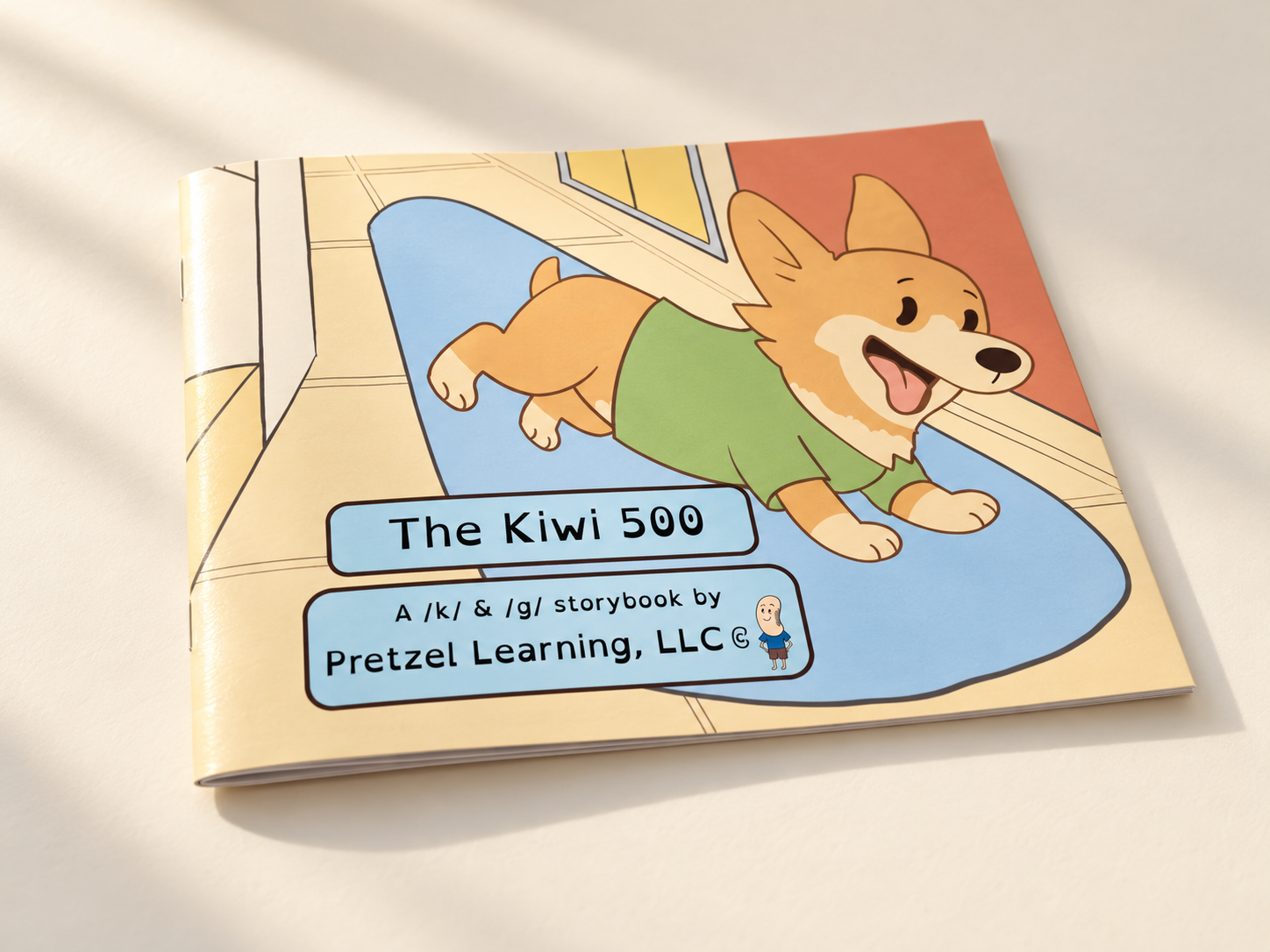 Image 1 of 1