FOR PRE-ORDER ONLY – (Expected Delivery in Q1 of 2027.)
Junior and Juniper
A Printed /dʒ/ Articulation & AAC Speech Therapy Storybook | Pretzel Learning, LLC
Join Junior and Juniper in this heartwarming, hand-illustrated speech therapy storybook designed to support articulation, language development, Augmentative and Alternative Communication (AAC), emotional regulation, and meaningful communication!
Moving to a new house isn't easy, especially for Junior. Surrounded by moving boxes and unable to find his favorite pirate adventure books, Junior feels frustrated and misses his old home.
Meanwhile, his younger sister Juniper sees the rainy day differently. With her AAC device by her side, she discovers opportunities for imagination, exploration, and play.
When an unexpected splash leads to a disagreement, Juniper uses her communication device to help Junior discover something special in the puddles outside.
Together, the siblings learn that imagination, patience, and understanding can help turn an unfamiliar place into a home.
Purposefully Designed for Speech Therapy
Unlike traditional children's books that are later adapted for therapeutic use, Junior and Juniper was developed specifically for speech-language therapy from the very beginning. Its narrative, vocabulary, illustrations, and speech sound targets were intentionally selected to support meaningful communication practice.
Designed for SLPs and SLPAs working with individual students or mixed-goal therapy groups, the storybook provides opportunities to address articulation, language, AAC, emotional regulation, and social communication objectives through a single narrative.
A distinguishing feature of this book is its natural integration of AAC into the characters' interactions, demonstrating how communication can support understanding, problem solving, and positive family relationships.
Targeted Articulation Through Connected Speech
The 28-page illustrated narrative places a primary emphasis on /dʒ/, the voiced postalveolar affricate commonly associated with the English "J" sound.
Primary Articulation Target:
Additional Articulation Targets:
The story incorporates these sounds within varied words and sentence structures, providing opportunities for articulation practice in meaningful, connected speech.
Clinicians can emphasize /dʒ/ production or incorporate additional targets depending on individual student needs.
The inclusion of multiple speech sounds makes Junior and Juniper especially useful for mixed-goal therapy groups.
Supporting AAC and Meaningful Communication
One of the most distinctive features of Junior and Juniper is its intentional representation of AAC as a functional part of everyday communication.
Throughout the story, Juniper uses her AAC device to express her interests, communicate with her family, and share ideas.
Her communication actively moves the story forward, helping Junior reconsider his frustration and discover new opportunities for play.
The narrative includes functional AAC vocabulary such as:
FUN
FORT
RAIN
OUTSIDE
HAPPY
WATCH
BOAT
HOME
These examples provide opportunities for clinicians to model AAC vocabulary, support expressive communication, and explore how different communication methods help people share their thoughts and needs.
Importantly, Juniper's AAC device is not simply a background feature. Her communication helps resolve the central conflict of the story, demonstrating the meaningful role AAC can play in relationships and everyday experiences.
Building Emotional Regulation, Perspective-Taking, and Family Relationships
Beyond articulation and AAC, Junior and Juniper explores the emotions that accompany significant changes.
Junior struggles to adjust to his family's new home. He misses familiar belongings, feels disappointed, and has difficulty recognizing opportunities for enjoyment in his new surroundings.
Juniper, however, approaches the rainy day with curiosity and excitement.
Their different perspectives create opportunities to explore emotional identification, empathy, flexible thinking, and understanding others' feelings.
When the siblings experience a disagreement, students can discuss how their emotions influence their actions and how communication helps them reconnect.
The story also encourages conversations about adapting to change, expressing frustration appropriately, and discovering positive experiences in unfamiliar environments.
These themes make the narrative useful for clinicians addressing social communication and emotional regulation alongside articulation and language development.
Supporting Language Development and Story Comprehension
The moving-day setting provides opportunities to develop expressive and receptive language through familiar situations and everyday vocabulary.
Students can describe the characters' surroundings, compare Junior's and Juniper's perspectives, and explain how their feelings change throughout the story.
The rainy-day activities also introduce opportunities to discuss imagination, object functions, and cooperative play.
Clinicians can use the narrative to practice sequencing, predictions, WH questions, cause-and-effect reasoning, and story retelling.
The sibling relationship also supports inferencing and perspective-taking as students consider why Junior initially feels upset and how Juniper's actions influence his emotions.
Speech and Language Goals Supported
Primary Articulation: /dʒ/ in connected speech
Additional Articulation: /tʃ/, /ʒ/, /ʃ/, /r/, /s/, and /z/
AAC and Multimodal Communication: AAC modeling, functional vocabulary, and expressive communication
Phonological Awareness: Target sound identification and auditory discrimination
Expressive and Receptive Language: Vocabulary development, descriptions, and comprehension
Narrative Skills: Sequencing, retelling, WH questions, and story comprehension
Higher-Level Language: Predictions, inferencing, comparing perspectives, and cause-and-effect reasoning
Emotional Development: Identifying frustration, adapting to change, and flexible thinking
Social Communication: Empathy, sibling relationships, cooperation, and resolving disagreements
Functional Communication: Expressing preferences, sharing ideas, and communicating emotions
Continuing the Story: Juniper's Adventure
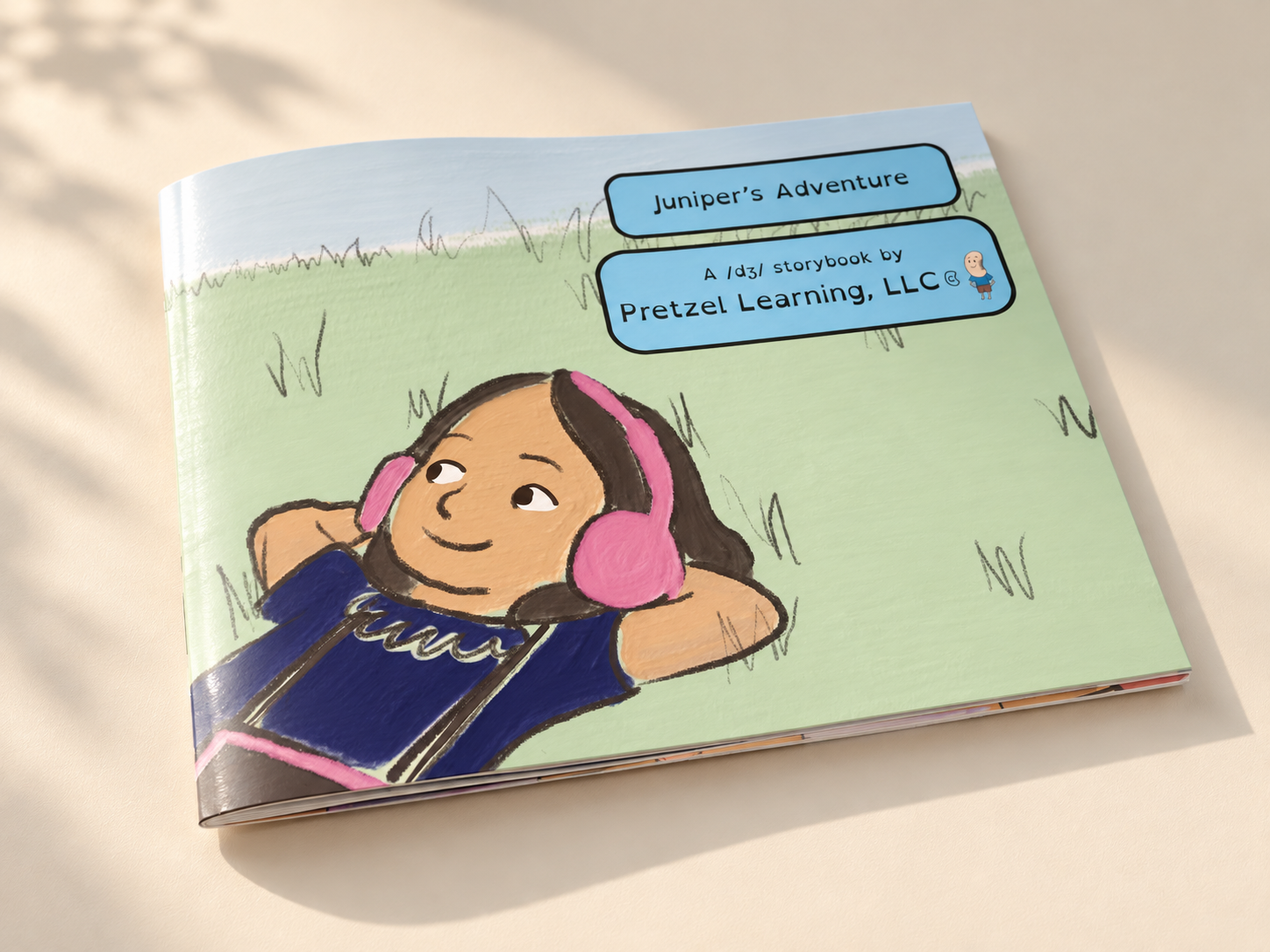
Junior and Juniper introduces the sibling characters who return in Pretzel Learning's companion storybook, Juniper's Adventure.
In the second story, Juniper explores a familiar park through her vivid imagination, using AAC and other communication methods to express her feelings, request help, and navigate unexpected experiences.
Although both books can be used independently, reading them together provides opportunities to revisit familiar characters, reinforce communication concepts, and explore how Juniper uses AAC across different settings.
Juniper's Adventure is available separately in the Pretzel Learning storybook collection.
More Than a Storybook: Coordinated Therapy Activities
At Pretzel Learning, LLC, we believe speech therapy storybooks should serve as a foundation for meaningful, connected learning and not simply as supplemental reading materials.
That's why Junior and Juniper was developed with coordinated articulation, language, and phonological activities in mind from the beginning.
These companion resources build directly upon the book's characters, vocabulary, narrative events, and targeted speech sounds, allowing clinicians to reinforce familiar concepts across multiple therapy sessions.
Companion activities may include articulation practice, phoneme tracking, auditory discrimination, AAC-based communication activities, vocabulary development, and narrative-based language exercises.
Coordinated companion activities are available separately as digital downloads on the Pretzel Learning website. These supplemental resources are not included with the purchase of the printed storybook.
Whether used independently or alongside its companion activities, Junior and Juniper provides clinicians with a flexible resource for addressing diverse communication goals while keeping students engaged in a story about family, understanding, and discovering joy in unexpected places.
Bring storytelling and speech therapy together with Pretzel Learning, where every story is built with communication in mind.
FOR PRE-ORDER ONLY – (Expected Delivery in Q1 of 2027.)
Junior and Juniper
A Printed /dʒ/ Articulation & AAC Speech Therapy Storybook | Pretzel Learning, LLC
Join Junior and Juniper in this heartwarming, hand-illustrated speech therapy storybook designed to support articulation, language development, Augmentative and Alternative Communication (AAC), emotional regulation, and meaningful communication!
Moving to a new house isn't easy, especially for Junior. Surrounded by moving boxes and unable to find his favorite pirate adventure books, Junior feels frustrated and misses his old home.
Meanwhile, his younger sister Juniper sees the rainy day differently. With her AAC device by her side, she discovers opportunities for imagination, exploration, and play.
When an unexpected splash leads to a disagreement, Juniper uses her communication device to help Junior discover something special in the puddles outside.
Together, the siblings learn that imagination, patience, and understanding can help turn an unfamiliar place into a home.
Purposefully Designed for Speech Therapy
Unlike traditional children's books that are later adapted for therapeutic use, Junior and Juniper was developed specifically for speech-language therapy from the very beginning. Its narrative, vocabulary, illustrations, and speech sound targets were intentionally selected to support meaningful communication practice.
Designed for SLPs and SLPAs working with individual students or mixed-goal therapy groups, the storybook provides opportunities to address articulation, language, AAC, emotional regulation, and social communication objectives through a single narrative.
A distinguishing feature of this book is its natural integration of AAC into the characters' interactions, demonstrating how communication can support understanding, problem solving, and positive family relationships.
Targeted Articulation Through Connected Speech
The 28-page illustrated narrative places a primary emphasis on /dʒ/, the voiced postalveolar affricate commonly associated with the English "J" sound.
Primary Articulation Target:
Additional Articulation Targets:
The story incorporates these sounds within varied words and sentence structures, providing opportunities for articulation practice in meaningful, connected speech.
Clinicians can emphasize /dʒ/ production or incorporate additional targets depending on individual student needs.
The inclusion of multiple speech sounds makes Junior and Juniper especially useful for mixed-goal therapy groups.
Supporting AAC and Meaningful Communication
One of the most distinctive features of Junior and Juniper is its intentional representation of AAC as a functional part of everyday communication.
Throughout the story, Juniper uses her AAC device to express her interests, communicate with her family, and share ideas.
Her communication actively moves the story forward, helping Junior reconsider his frustration and discover new opportunities for play.
The narrative includes functional AAC vocabulary such as:
FUN
FORT
RAIN
OUTSIDE
HAPPY
WATCH
BOAT
HOME
These examples provide opportunities for clinicians to model AAC vocabulary, support expressive communication, and explore how different communication methods help people share their thoughts and needs.
Importantly, Juniper's AAC device is not simply a background feature. Her communication helps resolve the central conflict of the story, demonstrating the meaningful role AAC can play in relationships and everyday experiences.
Building Emotional Regulation, Perspective-Taking, and Family Relationships
Beyond articulation and AAC, Junior and Juniper explores the emotions that accompany significant changes.
Junior struggles to adjust to his family's new home. He misses familiar belongings, feels disappointed, and has difficulty recognizing opportunities for enjoyment in his new surroundings.
Juniper, however, approaches the rainy day with curiosity and excitement.
Their different perspectives create opportunities to explore emotional identification, empathy, flexible thinking, and understanding others' feelings.
When the siblings experience a disagreement, students can discuss how their emotions influence their actions and how communication helps them reconnect.
The story also encourages conversations about adapting to change, expressing frustration appropriately, and discovering positive experiences in unfamiliar environments.
These themes make the narrative useful for clinicians addressing social communication and emotional regulation alongside articulation and language development.
Supporting Language Development and Story Comprehension
The moving-day setting provides opportunities to develop expressive and receptive language through familiar situations and everyday vocabulary.
Students can describe the characters' surroundings, compare Junior's and Juniper's perspectives, and explain how their feelings change throughout the story.
The rainy-day activities also introduce opportunities to discuss imagination, object functions, and cooperative play.
Clinicians can use the narrative to practice sequencing, predictions, WH questions, cause-and-effect reasoning, and story retelling.
The sibling relationship also supports inferencing and perspective-taking as students consider why Junior initially feels upset and how Juniper's actions influence his emotions.
Speech and Language Goals Supported
Primary Articulation: /dʒ/ in connected speech
Additional Articulation: /tʃ/, /ʒ/, /ʃ/, /r/, /s/, and /z/
AAC and Multimodal Communication: AAC modeling, functional vocabulary, and expressive communication
Phonological Awareness: Target sound identification and auditory discrimination
Expressive and Receptive Language: Vocabulary development, descriptions, and comprehension
Narrative Skills: Sequencing, retelling, WH questions, and story comprehension
Higher-Level Language: Predictions, inferencing, comparing perspectives, and cause-and-effect reasoning
Emotional Development: Identifying frustration, adapting to change, and flexible thinking
Social Communication: Empathy, sibling relationships, cooperation, and resolving disagreements
Functional Communication: Expressing preferences, sharing ideas, and communicating emotions
Continuing the Story: Juniper's Adventure
Junior and Juniper introduces the sibling characters who return in Pretzel Learning's companion storybook, Juniper's Adventure.
In the second story, Juniper explores a familiar park through her vivid imagination, using AAC and other communication methods to express her feelings, request help, and navigate unexpected experiences.
Although both books can be used independently, reading them together provides opportunities to revisit familiar characters, reinforce communication concepts, and explore how Juniper uses AAC across different settings.
Juniper's Adventure is available separately in the Pretzel Learning storybook collection.
More Than a Storybook: Coordinated Therapy Activities
At Pretzel Learning, LLC, we believe speech therapy storybooks should serve as a foundation for meaningful, connected learning and not simply as supplemental reading materials.
That's why Junior and Juniper was developed with coordinated articulation, language, and phonological activities in mind from the beginning.
These companion resources build directly upon the book's characters, vocabulary, narrative events, and targeted speech sounds, allowing clinicians to reinforce familiar concepts across multiple therapy sessions.
Companion activities may include articulation practice, phoneme tracking, auditory discrimination, AAC-based communication activities, vocabulary development, and narrative-based language exercises.
Coordinated companion activities are available separately as digital downloads on the Pretzel Learning website. These supplemental resources are not included with the purchase of the printed storybook.
Whether used independently or alongside its companion activities, Junior and Juniper provides clinicians with a flexible resource for addressing diverse communication goals while keeping students engaged in a story about family, understanding, and discovering joy in unexpected places.
Bring storytelling and speech therapy together with Pretzel Learning, where every story is built with communication in mind.


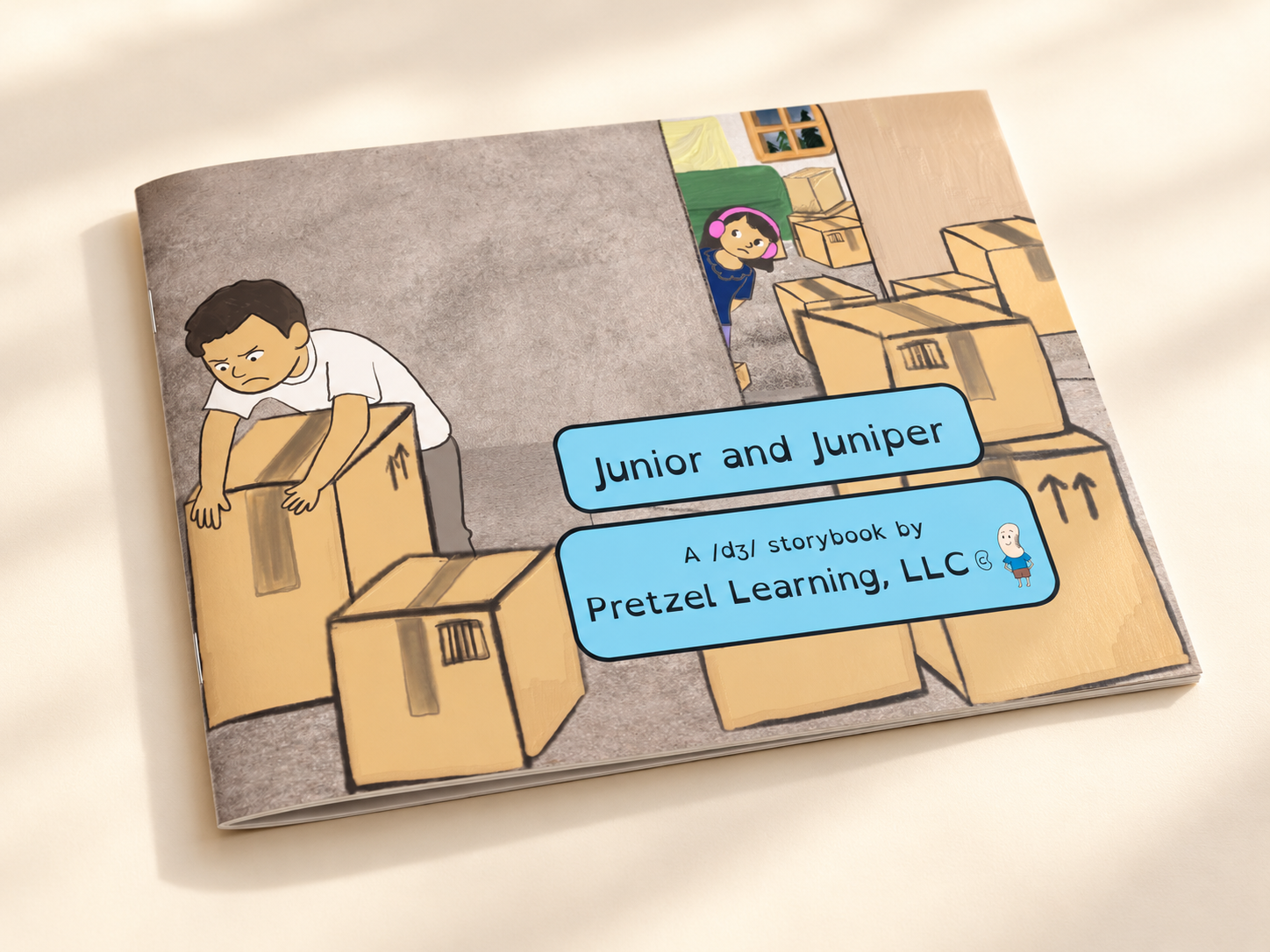 Image 1 of 1